Salience Network
Now that we've discussed the habit network, we can turn to the system responsible for allocating attention, cognitive, and emotional resources toward relevant stimuli — the Salience Network (SN).
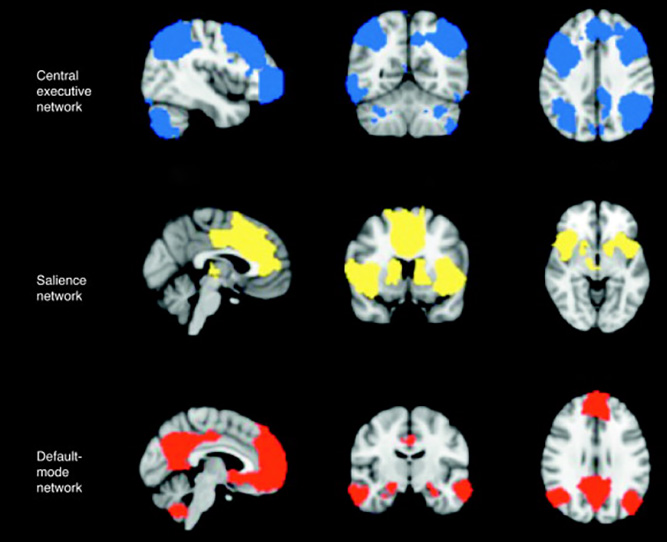
The SN serves as a key mediator within the Triple Network Model, working alongside the Default Mode Network (DMN) and the Central Executive Network (CEN) to dynamically switch attention and cognitive resources in response to environmental demands (Menon, 2011). When this system becomes disrupted, it can contribute to conditions such as depression, addiction, anhedonia (the reduced ability to experience pleasure or motivation), and psychosis (Lynch et al., 2024; Cushnie et al., 2023; Seeley et al., 2007).
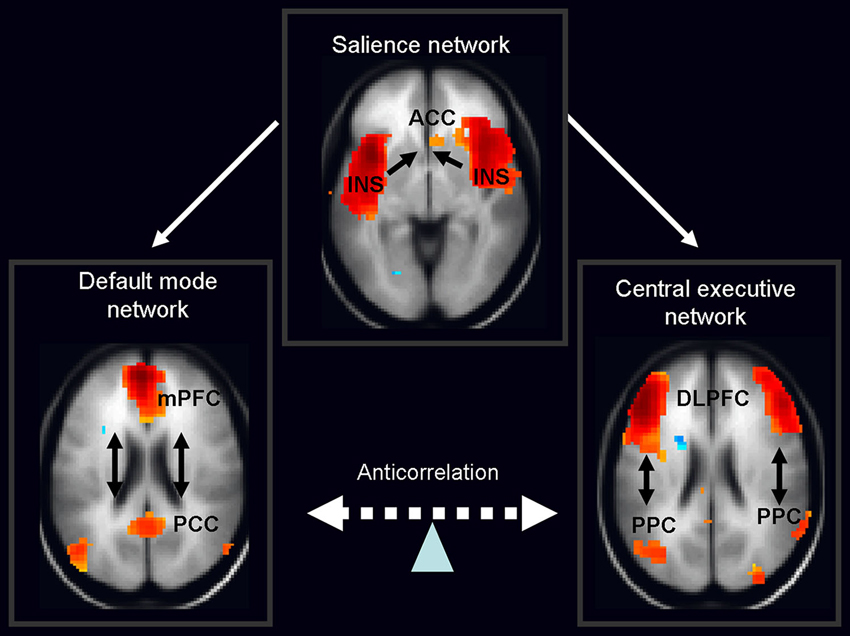
The SN is responsible for monitoring external and internal stimuli from our environment and assigning salience (importance) accordingly (Li et al., 2024). The network includes the anterior insula (AI) and the anterior cingulate cortex (ACC), which evaluate the relevance of sensory, emotional, and cognitive inputs. When a stimulus is deemed significant, the SN activates the CEN to engage focused attention and problem-solving, while suppressing the DMN, which is typically active during introspective or self-referential thought.
This switching mechanism enables the brain to transition efficiently between internal and external modes of processing, ensuring that cognitive and emotional resources are directed toward the most relevant or adaptive behaviors. Disruptions in this dynamic control have been associated with emotional dysregulation, motivational deficits, and cognitive inflexibility observed in several psychiatric disorders.
Default Mode Network
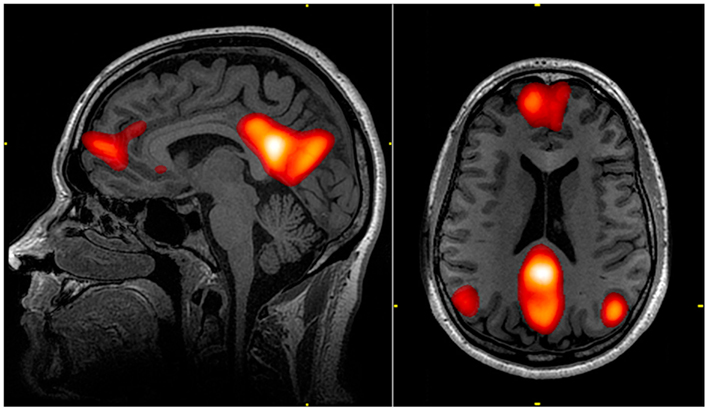
The Default Mode Network (DMN) is primarily active during rest, self-reflection, autobiographical memory, and mind-wandering. Core regions include the medial prefrontal cortex (mPFC), posterior cingulate cortex (PCC), and angular gyrus. This network supports our sense of self and continuity across time by integrating memory, emotion, and identity.
Under normal conditions, the DMN decreases its activity when the brain engages in goal-directed tasks, allowing attention to shift outward. However, excessive or persistent DMN activation can lead to rumination, self-focused worry, and negative emotional bias, which are commonly seen in depression and anxiety. Balanced modulation of the DMN by the Salience Network is therefore essential for maintaining psychological stability and adaptive self-awareness (Sheline et al., 2009).
Central Executive Network
The Central Executive Network (CEN), sometimes called the Frontoparietal Network, governs high-level cognitive functions such as working memory, problem-solving, and goal-directed behavior. Its core nodes include the dorsolateral prefrontal cortex (dlPFC) and the posterior parietal cortex (PPC).
The CEN is engaged when focused attention and cognitive control are required — for instance, during planning, reasoning, and inhibition of distractions. Proper communication between the CEN and the SN allows the brain to engage or disengage attention efficiently depending on task demands. When CEN regulation is impaired, individuals may experience poor concentration, executive dysfunction, and difficulty maintaining goals or adaptive decision-making, symptoms often seen in attention-deficit, obsessive-compulsive, and mood disorders (Bigliassi et al., 2025).
Integration and Therapeutic Relevance
Together, the Triple Network Model provides a unifying framework for understanding mental health through large-scale brain dynamics. Effective functioning relies on the balance and coordination between networks — the SN detecting salient stimuli, the CEN executing cognitive control, and the DMN supporting self-reflection and identity.
In psychotherapy and neurotherapeutic approaches, this model helps explain how treatments restore network balance.
- Mindfulness and meditation reduce DMN hyperactivity and strengthen SN–CEN connectivity, improving attention and emotional regulation.
- Cognitive-behavioral therapy (CBT) enhances CEN function by reinforcing adaptive cognitive control and reappraisal mechanisms.
- Neuromodulation techniques (like TMS and neurofeedback) target nodes within these networks to normalize connectivity patterns linked to depression, addiction, and trauma.
Ultimately, therapeutic interventions can be viewed as methods for recalibrating communication within and between the DMN, SN, and CEN — restoring flexible, context-sensitive coordination between thought, emotion, and action.
References
- Bigliassi, M., Cabral, D. F., & Evans, A. C. (2025). Improving brain health via the central executive network. The Journal of Physiology.
- Cushnie, A. K., Tang, W., & Heilbronner, S. R. (2023). Connecting circuits with networks in addiction neuroscience: a salience network perspective. International Journal of Molecular Sciences, 24(10), 9083.
- Li, X., Kass, G., Wiers, C. E., & Shi, Z. (2024). The brain salience network at the intersection of pain and substance use disorders: insights from functional neuroimaging research. Current Addiction Reports, 11(5), 797–808.
- Lynch, C. J., Elbau, I. G., Ng, T., Ayaz, A., Zhu, S., Wolk, D., ... & Liston, C. (2024). Frontostriatal salience network expansion in individuals with depression. Nature, 633(8030), 624–633.
- Menon, V. (2011). Large-scale brain networks and psychopathology: a unifying triple network model. Trends in Cognitive Sciences, 15(10), 483–506.
- Mulders, P. C., van Eijndhoven, P. F., Schene, A. H., Beckmann, C. F., & Tendolkar, I. (2015). Resting-state functional connectivity in major depressive disorder: a review. Neuroscience & Biobehavioral Reviews, 56, 330-344.
- Seeley, W. W., Menon, V., Schatzberg, A. F., Keller, J., Glover, G. H., Kenna, H., ... & Greicius, M. D. (2007). Dissociable intrinsic connectivity networks for salience processing and executive control. Journal of Neuroscience, 27(9), 2349–2356.
- Sheline, Y. I., Barch, D. M., Price, J. L., Rundle, M. M., Vaishnavi, S. N., Snyder, A. Z., ... & Raichle, M. E. (2009). The default mode network and self-referential processes in depression. Proceedings of the National Academy of Sciences, 106(6), 1942-1947.