It is difficult to introduce the next articles in this series (Logotherapy and Existential Psychology) without first examining the philosophical tradition from which they emerged. Although the foundations of existential thought were laid during the nineteenth century by philosophers such as Søren Kierkegaard and Friedrich Nietzsche, existentialism became particularly influential after the Second World War. The devastation of the Holocaust, the destruction caused by global conflict, and the emergence of nuclear weapons led many to question the nature of human existence, freedom, responsibility, suffering, and meaning (Aho, 2014, 2023; Krill, 1966; More, 2016).
Philosophers and literary figures including Friedrich Nietzsche, Fyodor Dostoevsky, Jean-Paul Sartre, Simone de Beauvoir, and Albert Camus explored these questions from different perspectives. Their work challenged established assumptions about morality, purpose, and the individual, encouraging readers to reconsider what it means to live an authentic and meaningful life in an uncertain world. These ideas later influenced the development of existential psychology and psychotherapeutic approaches such as Logotherapy.
Within this philosophical climate, psychiatrists and psychologists began asking whether human suffering could be understood not only through psychopathology but also through questions of existence, purpose, and meaning. Two influential responses to these questions were Logotherapy and Existential Therapy.
Logotherapy
Logotherapy is recognized as the Third Viennese School of Psychotherapy, following Sigmund Freud's psychoanalysis and Alfred Adler's individual psychology. Freud proposed that human behavior is primarily motivated by the pursuit of pleasure and the satisfaction of instinctual drives, suggesting that psychological distress often arises from unconscious conflicts rooted in early life experiences. Adler, by contrast, emphasized the individual's striving to overcome feelings of inferiority while highlighting the importance of purpose, social interest, and personal responsibility. Rather than rejecting either perspective, Viktor Frankl argued that both approaches overlooked an essential dimension of human existence: the noetic or spiritual dimension. Frankl adopted the German term Geist, a concept with a long tradition in German philosophy, to describe the uniquely human capacity for meaning, values, conscience, and responsibility rather than referring to spirituality in a religious sense (Frankl, 1986, pp. 3–22).
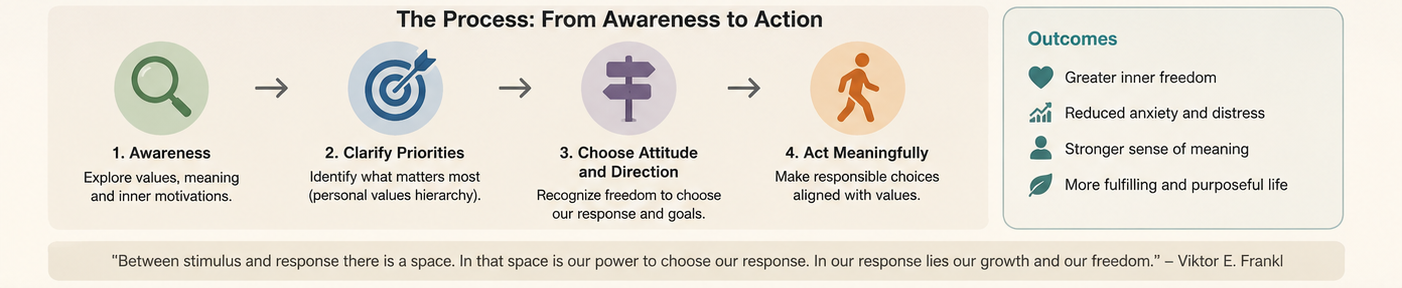
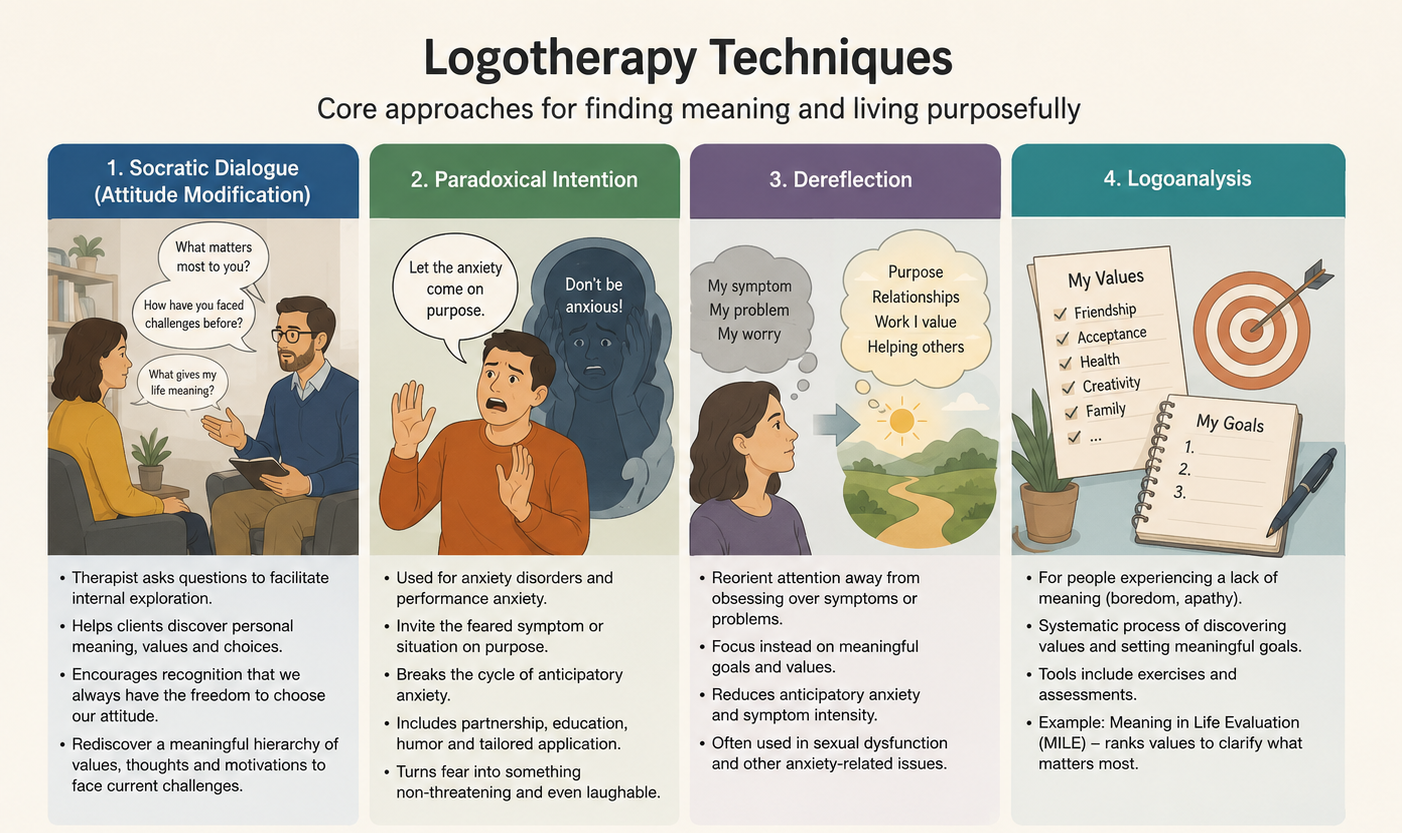
Logotherapy is derived from the Greek word logos, commonly translated as "meaning," and emphasizes the uniquely human capacity to discover and pursue meaning in life (Schulenberg et al., 2008). As discussed in previous articles on the work of Abraham Maslow, Carl Rogers, Marsha Linehan, and Steven Hayes, many contemporary therapeutic approaches, supported by an expanding body of empirical research, recognize the importance of meaning and purpose for psychological well-being. Consistent with these approaches, the role of the logotherapist is to regard clients as fellow human beings rather than merely as patients, encouraging them to take an active role in the therapeutic process. Through this collaborative relationship, clients are supported in clarifying what they find personally meaningful, identifying their values and life goals, and recognizing their freedom to make responsible choices. Rather than encouraging excessive self-focus, Logotherapy seeks to foster self-transcendence by helping individuals orient themselves toward meaningful pursuits, relationships, and responsibilities (Schulenberg et al., 2008; Szabó & Baji, 2025).
Existential Therapy
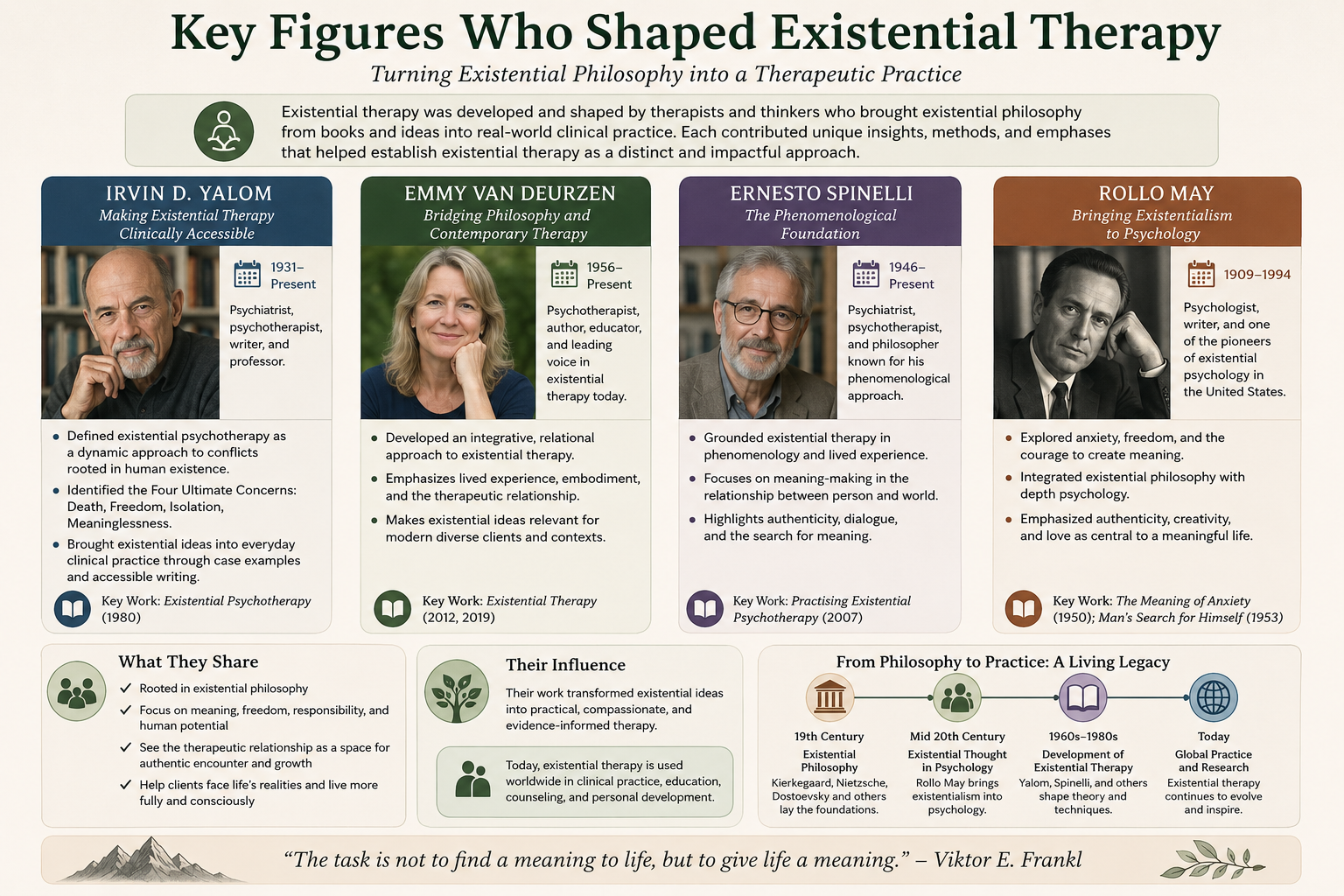
Similar to Logotherapy, existential therapy emerged from existential philosophy, which gained widespread prominence following the Second World War. Drawing upon this philosophical tradition, clinicians including Rollo May, Irvin D. Yalom, Emmy van Deurzen, and Ernesto Spinelli helped establish existential therapy as a distinct psychotherapeutic approach. Among these, Yalom played a particularly influential role in making existential psychotherapy clinically accessible. He described it as a dynamic approach to psychotherapy that focuses on conflicts rooted in the fundamental realities of human existence rather than solely on psychopathology (Yalom, 1980).
According to Yalom (1980), understanding these existential conflicts requires therapists to attend to multiple sources of information, including the client's life history, dreams, emotions, spontaneous insights, and interpersonal relationships. He argued that periods of solitude, reflection, and honest self-examination allow individuals to confront the fundamental conditions of existence and recognize what he described as the four ultimate concerns: death, freedom, existential isolation, and meaninglessness (Yalom, 1980, pp. 1–26).
According to Yalom (1980), these four concerns are unavoidable aspects of being human rather than symptoms of mental illness. Death reminds individuals of life's finitude; freedom highlights the responsibility that accompanies personal choice; existential isolation refers to the realization that each individual ultimately experiences life from a unique perspective; and meaninglessness reflects the challenge of constructing purpose within an uncertain world. Existential therapists aim to help clients engage with these realities rather than avoid them, fostering authenticity, responsibility, and psychological growth.
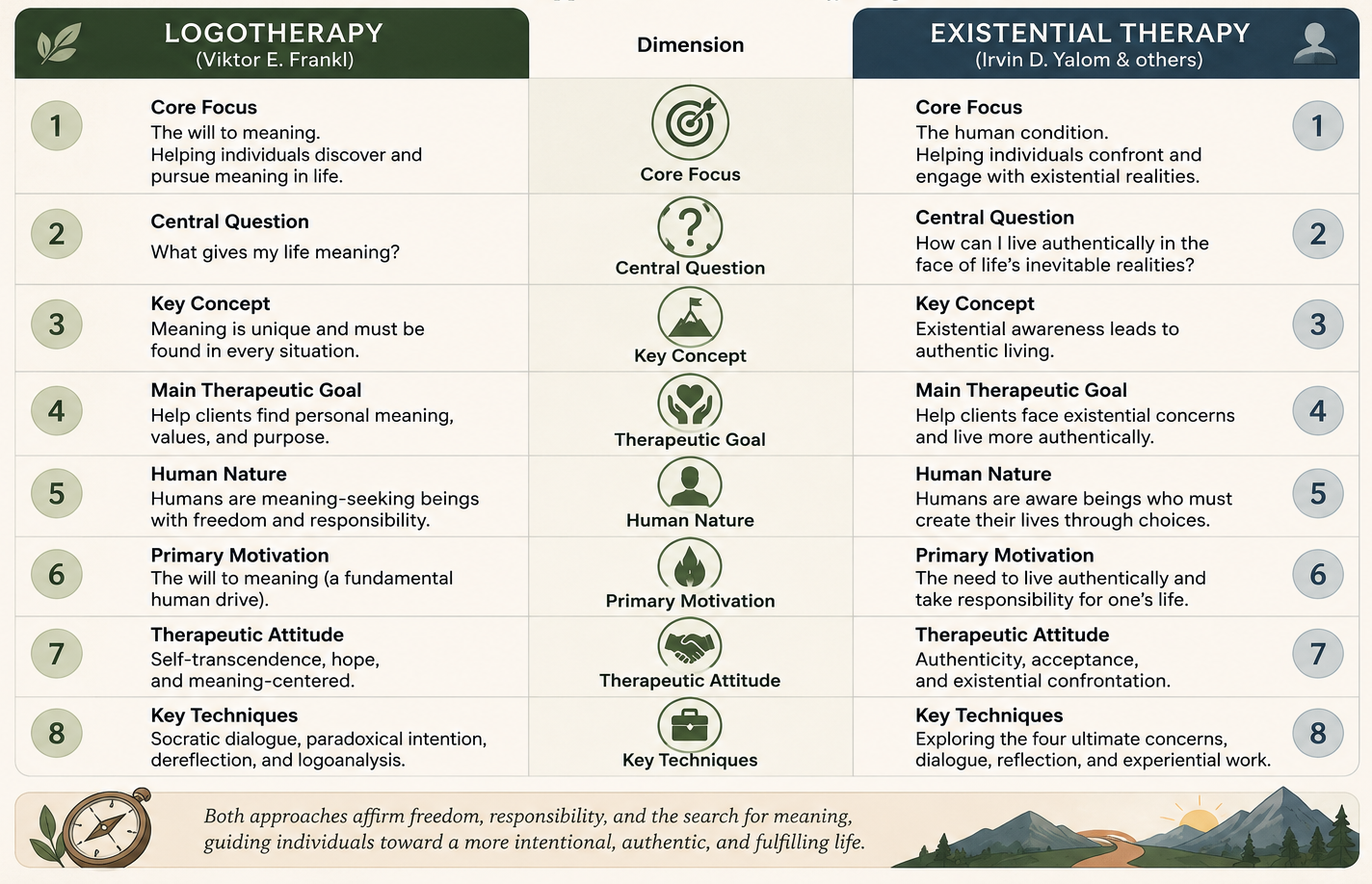
While Logotherapy and Existential Therapy differ in emphasis, both view psychological suffering as extending beyond symptoms alone. Rather than asking only "What is wrong?", these approaches encourage a deeper question: "How can I live authentically and meaningfully despite suffering, uncertainty, and the limitations of existence?" In doing so, they remind us that mental health is not solely the absence of distress but also the ongoing pursuit of purpose, responsibility, and personal growth.
References
- Aho, K. (2014, 2023). Existentialism: An introduction. John Wiley & Sons. https://plato.stanford.edu/entries/existentialism/
- Frankl, V. E. (1986). The doctor and the soul: From psychotherapy to logotherapy (R. Winston & C. Winston, Trans., Rev. and expanded ed.). Vintage Books. (Original work published 1946).
- Krill, D. F. (1966). Existentialism: A philosophy for our current revolutions. Social Service Review, 40(3), 289–301. https://doi.org/10.1086/641937
- More, V. (2016). Existentialism: A philosophic stand point to existence over essence. The South Asian Academic Research Chronicle, 3(1), 12–20.
- Schulenberg, S. E., Hutzell, R. R., Nassif, C., & Rogina, J. M. (2008). Logotherapy for clinical practice. Psychotherapy: Theory, Research, Practice, Training, 45(4), 447. https://doi.org/10.1037/a0014331
- Szabó, K., & Baji, I. (2025). The current status and applications of logotherapy and existential analysis: A narrative review. Developments in Health Sciences, 8(2), 82–100. https://doi.org/10.1556/2066.2025.00083
- Yalom, I. D. (1980). Existential psychotherapy. Basic Books.