Behavioral sciences and applied intervention strategies have gained increasing attention in recent years as researchers continue to examine the relationship between human behavior and long-term health outcomes (Bran et al., 2022). A growing body of evidence suggests that behavioral patterns (including smoking, diet, physical inactivity, chronic stress, disrupted sleep, and social disconnection) can significantly influence the development and progression of chronic illnesses such as cardiovascular disease, metabolic disorders, inflammation, and certain forms of cancer (Rahelić et al., 2024; Glanz & Bishop, 2010).
Exposure Therapy
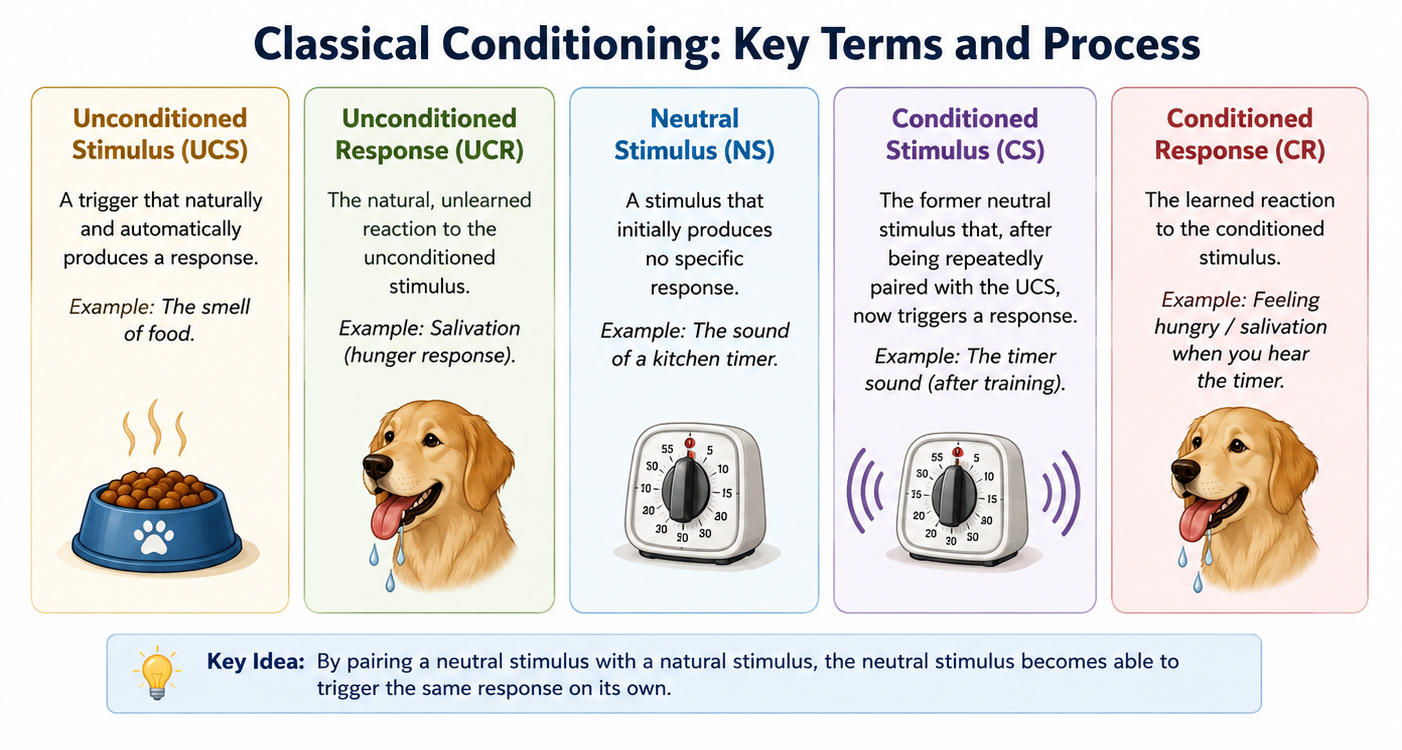
Exposure therapy emerged from foundational principles of classical conditioning, a form of associative learning that explains how organisms learn relationships between environmental stimuli and biological responses (Foa et al., 2016). First described by Ivan Pavlov in the 1890s, classical conditioning demonstrates how biologically meaningful stimuli can become associated with previously neutral environmental cues through repeated pairing.
A well-known example comes from Pavlov's experiments with dogs. Food naturally produced salivation, an unconditioned response, because it required no prior learning. When a neutral stimulus, such as a bell, was repeatedly presented before feeding, the dogs gradually began salivating in anticipation of food. Over time, the previously neutral sound became a conditioned stimulus, capable of eliciting a learned or conditioned response, even in the absence of food.
In everyday life, similar associative processes occur continuously. For example, a school bell may become associated with recess or the end of classes, while the sound of a notification tone may evoke anticipation, anxiety, or excitement depending on prior experiences. Early behavioral models such as Mowrer's Two-Factor Theory further explain how fears are initially acquired through classical conditioning and subsequently maintained through operant conditioning, particularly through avoidance behaviors.
These principles became foundational for the development of exposure therapy, particularly in the treatment of anxiety-related conditions such as phobias, trauma-related disorders, panic disorder, and obsessive-compulsive symptoms (Robjant & Fazel, 2010; Böhnlein et al., 2020; Foa et al., 2016). From a behavioral perspective, many anxiety disorders emerge when previously neutral situations, objects, or environments become associated with fear through learning processes. For instance, an individual involved in a car accident may later experience intense anxiety when driving, even under objectively safe conditions.
Exposure therapy seeks to gradually weaken these learned fear associations through systematic and controlled confrontation with feared stimuli. Rather than avoiding anxiety-provoking experiences, individuals are supported in safely approaching them, allowing new learning to occur. Over repeated exposure, feared outcomes often fail to materialize, creating opportunities for extinction learning, in which new safety-based associations begin to compete with previously learned fear responses.
Behavioral Activation
Behavioral Activation (BA) emerged from behavioral foundations of Cognitive Behavioral Therapy (CBT) during the 1970s and was developed as an intervention for depression centered on restoring meaningful behavioral engagement (Wang & Feng, 2022). Unlike traditional cognitive approaches that primarily target dysfunctional beliefs and maladaptive thought patterns, Behavioral Activation operates under the premise that emotional states are strongly influenced by behavior and environmental reinforcement.
Behavioral models of depression suggest that individuals experiencing low mood often withdraw from activities that once provided pleasure, accomplishment, or social connection. Although avoidance may temporarily reduce emotional discomfort, prolonged disengagement can unintentionally reinforce depressive symptoms by reducing opportunities for positive reinforcement.
Behavioral Activation seeks to interrupt this cycle by encouraging gradual participation in meaningful, rewarding, and goal-directed activities. Rather than waiting for motivation to naturally emerge, individuals are supported in engaging in adaptive behaviors despite low energy or emotional distress.
Modern Behavioral Activation approaches have also integrated therapeutic perspectives that emerged during the third wave of psychotherapy, including mindfulness-based awareness, acceptance strategies, and values-oriented action (Wong et al., 2018). In practice, Behavioral Activation may involve activity monitoring, behavioral scheduling, values exploration, goal setting, contingency management, relaxation strategies, social skills development, and reducing patterns of avoidance or behavioral disengagement (Kanter et al., 2010).

Habit Reversal Training
Before breaking down the next section, it is important to understand what habits are, how current models conceptualize their development and how in treatment in turn targets them.
Habits are memory-based tendencies to respond to specific cues automatically, acquired through repetition within stable contexts which are acquired through repetition within stable contexts (Verplanken, & Wood, 2006; Maio et al., 2018, pp. 148). According to the Composite Model of attitude-behavior relations proposed by Eagly and Chaiken (1998), behavior is influenced by an interaction of attitudes, habitual tendencies, and anticipated outcomes rather than by attitudes alone. This perspective recognizes that repeated responses in stable contexts may become habitual and therefore exert a more automatic influence on action alongside conscious evaluations and intentions (Eagly & Chaiken, 1998; as cited Maio et al., 2018, pp. 148).
From a behavioral perspective, problematic habits develop when repeated behaviors become strongly associated with particular internal or external cues. Over time, these responses may become increasingly automatic, requiring little conscious deliberation. As a result, individuals may continue engaging in behaviors despite negative consequences or intentions to stop.
Habit Reversal Training (HRT) was developed by Azrin and Nunn (1973) as a behavioral intervention designed to reduce unwanted habitual behaviors through increased awareness and behavioral substitution. HRT has been applied to conditions including tic disorders, trichotillomania (hair-pulling disorder), excoriation disorder (skin-picking disorder), nail biting, and other repetitive behaviors (Bate et al., 2011).

Problem-Solving Therapy
Problem-Solving Therapy (PST) is a structured cognitive-behavioral intervention designed to improve an individual's ability to cope with stressful life experiences and everyday challenges (D'Zurilla & Goldfried, 1971; D'Zurilla & Nezu, 2007). The approach is based on the assumption that psychological distress may be exacerbated when individuals perceive problems as overwhelming, unsolvable, or beyond their capacity to manage effectively. Rather than focusing solely on symptom reduction, PST aims to strengthen adaptive coping skills by teaching a systematic approach to identifying and addressing problems. Individuals are encouraged to define problems clearly, generate multiple solutions, evaluate potential outcomes, implement a chosen strategy, and review its effectiveness. By promoting active coping and reducing avoidance, PST seeks to improve psychological well-being through practical problem-solving skills and increased self-efficacy (Bell & D'Zurilla, 2009).
References
- Azrin, N. H., & Nunn, R. G. (1973). Habit-reversal: a method of eliminating nervous habits and tics. Behaviour research and therapy, 11(4), 619-628. https://doi.org/10.1016/0005-7967(73)90119-8
- Bate, K. S., Malouff, J. M., Thorsteinsson, E. T., & Bhullar, N. (2011). The efficacy of habit reversal therapy for tics, habit disorders, and stuttering: a meta-analytic review. Clinical Psychology Review, 31(5), 865-871. https://doi.org/10.1016/j.cpr.2011.03.013
- Bell, A. C., & D'Zurilla, T. J. (2009). Problem-solving therapy for depression: A meta-analysis. Clinical Psychology Review, 29(4), 348-353. https://doi.org/10.1016/j.cpr.2009.02.003
- Böhnlein, J., Altegoer, L., Muck, N. K., Roesmann, K., Redlich, R., Dannlowski, U., & Leehr, E. J. (2020). Factors influencing the success of exposure therapy for specific phobia: A systematic review. Neuroscience & Biobehavioral Reviews, 108, 796-820. https://doi.org/10.1016/j.neubiorev.2019.12.009
- Bryan, C. J., Tipton, E., & Yeager, D. S. (2021). Behavioural science is unlikely to change the world without a heterogeneity revolution. Nature human behaviour, 5(8), 980-989. https://doi.org/10.1038/s41562-021-01143-3
- D'Zurilla, T. J., & Goldfried, M. R. (1971). Problem solving and behavior modification. Journal of Abnormal Psychology, 78(1), 107-126. https://doi.org/10.1037/h0031360
- D'Zurilla, T. J., & Nezu, A. M. (2007). Problem-Solving Therapy: A Positive Approach to Clinical Intervention (3rd ed.). Springer.
- Foa, E. B., & McLean, C. P. (2016). The efficacy of exposure therapy for anxiety-related disorders and its underlying mechanisms: The case of OCD and PTSD. Annual review of clinical psychology, 12(1), 1-28. https://doi.org/10.1146/annurev-clinpsy-021815-093533
- Glanz, K., & Bishop, D. B. (2010). The role of behavioral science theory in development and implementation of public health interventions. Annual review of public health, 31(1), 399-418. https://doi.org/10.1146/annurev.publhealth.012809.103604
- Kanter, J. W., Manos, R. C., Bowe, W. M., Baruch, D. E., Busch, A. M., & Rusch, L. C. (2010). What is behavioral activation?: A review of the empirical literature. Clinical psychology review, 30(6), 608-620. https://doi.org/10.1016/j.cpr.2010.04.001
- Maio, G. R., Verplanken, B., & Haddock, G. (2018). The psychology of attitudes and attitude change.
- Rahelić, V., Perković, T., Romić, L., Perković, P., Klobučar, S., Pavić, E., & Rahelić, D. (2024, December). The role of behavioral factors on chronic diseases-Practice and knowledge gaps. In Healthcare (Vol. 12, No. 24, p. 2520). MDPI. https://doi.org/10.3390/healthcare12242520
- Robjant, K., & Fazel, M. (2010). The emerging evidence for narrative exposure therapy: A review. Clinical psychology review, 30(8), 1030-1039. http://dx.doi.org/10.1016/j.cpr.2010.07.004
- Verplanken, B., & Wood, W. (2006). Interventions to break and create consumer habits. Journal of public policy & marketing, 25(1), 90-103. https://doi.org/10.1509/jppm.25.1.90
- Wang, X., & Feng, Z. (2022). A narrative review of empirical literature of behavioral activation treatment for depression. Frontiers in Psychiatry, 13, 845138. https://doi.org/10.3389/fpsyt.2022.845138
- Wong, S. Y., Sun, Y. Y., Chan, A. T., Leung, M. K., Chao, D. V., Li, C. C., ... & Yip, B. H. (2018). Treating subthreshold depression in primary care: a randomized controlled trial of behavioral activation with mindfulness. The annals of family medicine, 16(2), 111-119. https://doi.org/10.1370/afm.2206