Contemplative therapeutic approaches have contributed to the emergence of therapies that incorporate elements of mindfulness, acceptance, and philosophical reflection. These developments reflect a broader shift in psychology toward integrating practices that were historically considered outside the scope of empirical science.
According to Hayes (2004), the development of cognitive-behavioral therapies can be understood across three distinct "waves." The first wave, emerging in the mid-20th century, was grounded in behaviorism, with theorists such as B. F. Skinner and Hans Eysenck emphasizing observable behavior and learning principles such as conditioning. The second wave, developing from the late 1960s onward, introduced cognitive approaches, highlighting the role of thoughts, beliefs, and language in the development and maintenance of psychological disorders.
The third wave of therapies builds upon these foundations while expanding their focus. Rather than mainly targeting the content of thoughts, these approaches emphasize the individual's relationship with their internal experiences. Therapies such as Acceptance and Commitment Therapy (ACT), Dialectical Behavior Therapy (DBT), and Mindfulness-Based Cognitive Therapy (MBCT) aim to enhance psychological flexibility through processes such as acceptance, mindfulness, and values-based action (Hayes, 2004; Herbert & Forman, 2011).
Dialectical Behavioral Therapy (DBT)
Dialectical Behavior Therapy (DBT) was developed by Dr. Marsha Linehan in the late 1980s to treat individuals experiencing chronic suicidality and borderline personality disorder (Linehan et al., 1991, as cited in Panos et al., 2014). Since its development, DBT has been applied to a range of conditions characterized by emotional dysregulation.
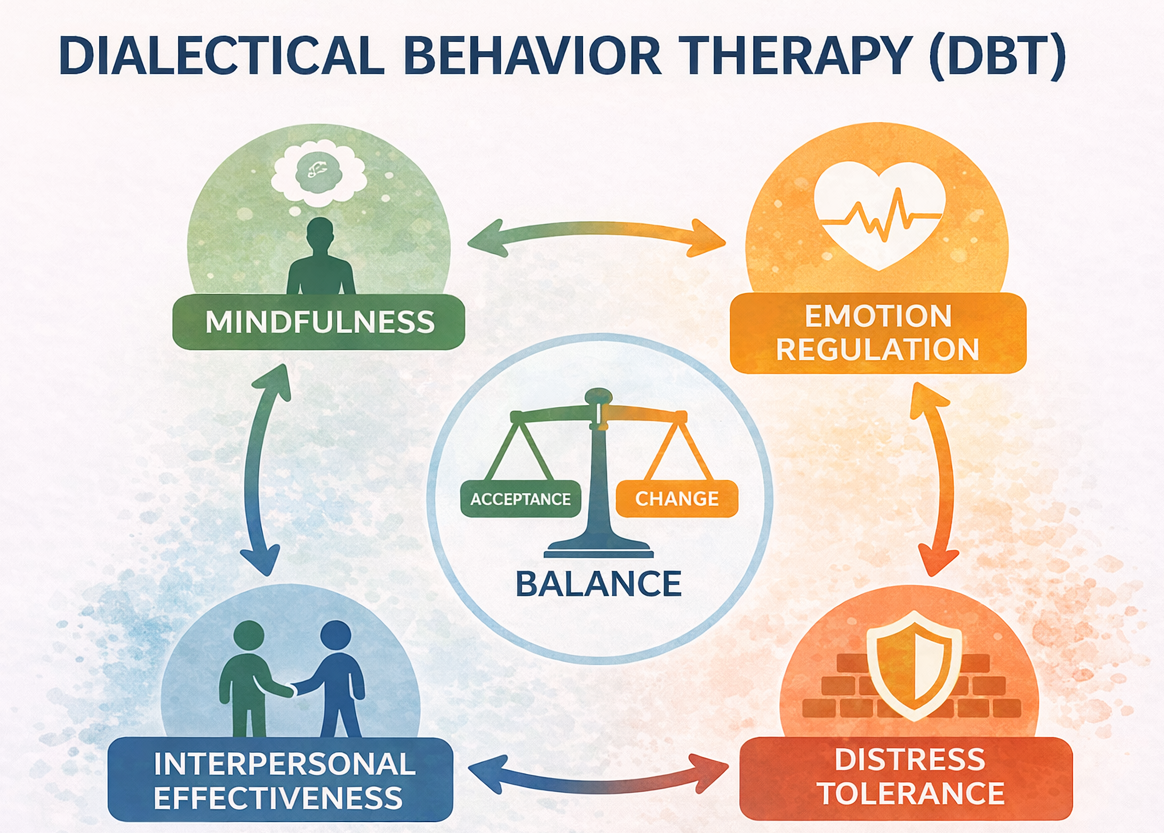
Within this framework, treatment focuses on enhancing skills in four key domains: emotional regulation, distress tolerance, interpersonal effectiveness, and mindfulness. These components aim to help individuals manage intense emotions, navigate interpersonal relationships more effectively, and cope with distress without engaging in harmful behaviors.
A central assumption of DBT is that individuals who experience chronic suicidal ideation often perceive their lives as unmanageable or lacking meaning. As such, therapy emphasizes both acceptance and change, supporting individuals in building a "life worth living" through the development of adaptive coping strategies and meaningful interpersonal connections (Robins & Rosenthal, 2011).
At its core, DBT focuses on four key treatment targets: minimizing life-threatening behaviors, reducing actions that disrupt therapy, addressing behaviors that negatively impact quality of life, and developing more effective coping skills (Panos et al., 2014).
Acceptance and Commitment Therapy (ACT)
Acceptance and Commitment Therapy (ACT) was developed by Steven C. Hayes and is grounded in Relational Frame Theory (RFT), a behavioral account of human language and cognition (Hayes, 2004). RFT proposes that humans have the ability to form bidirectional and complex relationships between stimuli through language, allowing for abstract thinking and higher-order learning (Hayes & Pierson, 1999).
While this capacity is essential for learning, it also enables individuals to form arbitrary and sometimes unhelpful associations between thoughts, emotions, and experiences. For example, through relational reasoning, individuals may derive conclusions beyond direct experience (e.g., if A is smaller than B, and B is smaller than C, then A is smaller than C). Although adaptive in many contexts, this process can contribute to psychological distress when individuals become entangled in rigid or maladaptive cognitive patterns.
Within ACT, psychological suffering is understood to arise not from thoughts themselves, but from the way individuals relate to and become fused with these internal experiences. Hayes conceptualized maladaptive patterns through the acronym FEAR, which describes processes that maintain psychological inflexibility.
F: Fusion (Cognitive Fusion)
Cognitive fusion refers to the tendency to become entangled with thoughts, treating them as literal truths rather than as mental events. Individuals rely heavily on their internal dialogue to interpret and evaluate experiences, which can shape their behavior in rigid ways.
E: Evaluation
Evaluation involves judging thoughts, emotions, and experiences as inherently good or bad. Over time, individuals may begin to perceive these evaluations as objective truths rather than subjective interpretations, reinforcing maladaptive patterns of thinking.
A: Avoidance (Experiential Avoidance)
Experiential avoidance occurs when individuals attempt to avoid, suppress, or escape internal experiences such as thoughts, emotions, or bodily sensations. Triggers—whether internal or external—are often avoided in an effort to reduce discomfort, which can maintain psychological distress.
R: Reasons (Reason-Giving)
Reason-giving refers to the tendency to use thoughts and beliefs as justifications for behavior, particularly avoidance or inaction (e.g., "There is something wrong with me, so I cannot do this"). These narratives can reinforce existing schemas and limit behavioral flexibility.
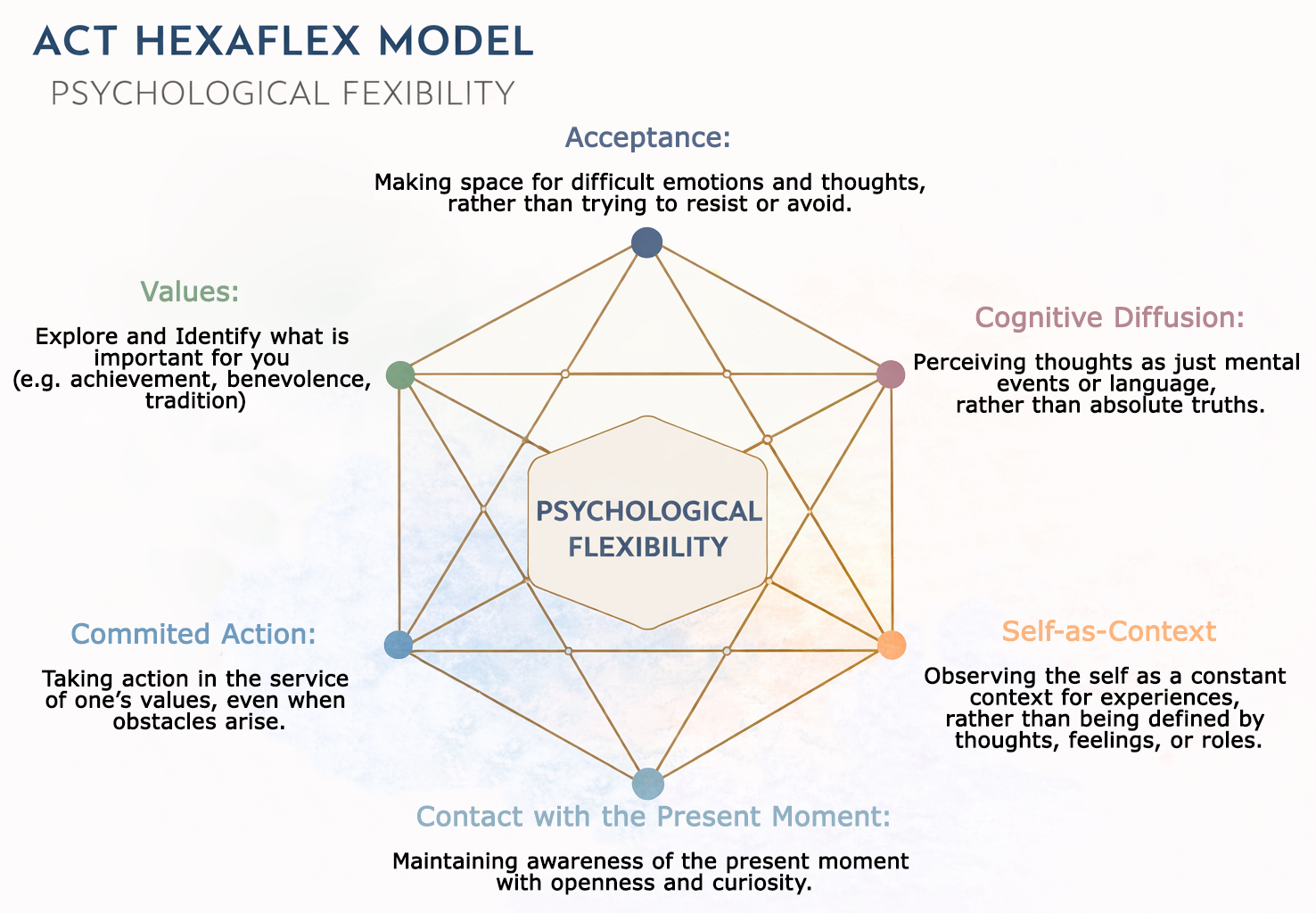
Within ACT, psychological functioning is understood along a continuum between psychological inflexibility and psychological flexibility. Psychological inflexibility refers to a rigid pattern of responding in which individuals become entangled with their thoughts, avoid or suppress internal experiences, and behave in ways that are disconnected from their values. This pattern often maintains emotional distress and limits adaptive functioning. In contrast, psychological flexibility involves the capacity to remain in contact with the present moment, accept internal experiences without unnecessary defense, and engage in behavior that is aligned with personally meaningful values, even in the presence of discomfort (Hayes, 2004; Prine, 2025).
Acceptance
Acceptance refers to the active and intentional willingness to experience thoughts, emotions, and bodily sensations without attempting to avoid, suppress, or control them.
Cognitive Diffusion
Cognitive diffusion involves altering the way individuals relate to their thoughts, recognizing them as transient mental events rather than literal truths or accurate representations of reality.
Self-as-Context
Self-as-context describes the capacity to observe one's experiences from a stable and continuous perspective, distinguishing the self from the content of thoughts, emotions, and roles.
Contact with the Present Moment
Contact with the present moment refers to the ongoing, non-judgmental awareness of internal and external experiences as they occur in real time.
Values
Values are enduring, personally meaningful life directions that guide behavior and provide a sense of purpose and coherence.
Committed Action
Committed action involves the consistent engagement in behaviors aligned with one's values, even in the presence of psychological discomfort or obstacles.
Mindfulness-Based Cognitive Therapy (MBCT)
Mindfulness-Based Cognitive Therapy (MBCT) was developed as an adaptation of Mindfulness-Based Stress Reduction (MBSR), integrating mindfulness practices with cognitive-behavioral principles to specifically target relapse in depression but since has been developed to be applicable in different contexts (Alsubaie et al., 2017).
Mindfulness-Based Cognitive Therapy (MBCT) was originally developed to reduce relapse in individuals with recurrent depression. A key mechanism underlying depressive relapse is rumination, characterized by repetitive and passive focus on past negative experiences or perceived failures. Similarly, anxiety is often associated with persistent worry oriented toward future threats. Individuals experiencing depression or anxiety are more likely to engage in maladaptive cognitive patterns, such as catastrophizing, particularly when confronted with everyday stressors that others may perceive as manageable.
MBCT was developed to address these patterns by combining mindfulness practices with cognitive-behavioral principles. Through this integration, individuals are supported in cultivating greater awareness of their thoughts and emotional states, allowing them to relate to these experiences in a more adaptive and less reactive manner. This approach promotes a present-focused perspective and encourages behavioral responses that are aligned with personal values (Sipe & Eisendrath, 2012).
| Common Third-Wave Therapeutic Techniques | Description |
|---|---|
| Cognitive Diffusion | Observing thoughts as mental events rather than literal truths |
| Distress Tolerance | Developing skills to cope with crisis situations without worsening them |
| Emotion Regulation | Learning to understand and manage intense emotional responses |
| Interpersonal Effectiveness | Enhancing communication and relationship skills |
| Body Scan / Meditation | Increasing awareness of bodily sensations and internal states |
References
- Alsubaie, M., Abbott, R., Dunn, B., Dickens, C., Keil, T. F., Henley, W., & Kuyken, W. (2017). Mechanisms of action in mindfulness-based cognitive therapy (MBCT) and mindfulness-based stress reduction (MBSR) in people with physical and/or psychological conditions: A systematic review. Clinical psychology review, 55, 74-91.
- Hayes, S. C. (2004). Acceptance and commitment therapy, relational frame theory, and the third wave of behavioral and cognitive therapies. Behavior therapy, 35(4), 639-665.
- Hayes, S. C., & Pierson, H. (1999). Acceptance and commitment therapy. In Encyclopedia of cognitive behavior therapy (pp. 1-4). Boston, MA: Springer US.
- Herbert, J. D., & Forman, E. M. (2011). The evolution of cognitive behavior therapy: The rise of psychological acceptance and mindfulness. Acceptance and mindfulness in cognitive behavior therapy: Understanding and applying the new therapies, 1-25.
- Panos, P. T., Jackson, J. W., Hasan, O., & Panos, A. (2014). Meta-analysis and systematic review assessing the efficacy of dialectical behavior therapy (DBT). Research on social work practice, 24(2), 213-223.
- Prine, A. (2025). ACT ON PRINCIPAL: IDENTIFYING THE IMPORTANCE OF HEXAFLEX PROCESSES ON SELF-REPORTED STRESS IN EDUCATIONAL LEADERS.
- Robins, C. J., & Rosenthal, M. Z. (2011). Dialectical behavior therapy. Acceptance and mindfulness in cognitive behavior therapy: Understanding and applying the new therapies, 164-192.
- Sipe, W. E., & Eisendrath, S. J. (2012). Mindfulness-based cognitive therapy: theory and practice. The Canadian Journal of Psychiatry, 57(2), 63-69.