Mental health as a scientific discipline is relatively recent, gaining broader recognition within the scientific and medical communities after the end of the Second World War. Prior to the establishment of the World Health Organization (WHO) and the expansion of international mental health initiatives in the late 1940s, mental health was commonly referred to as mental hygiene. The Mental Hygiene Movement, which began in 1908, sought to reform societal attitudes toward mental illness and improve the treatment of individuals experiencing psychological disorders. This movement is often attributed to the work of Clifford Whittingham Beers, whose autobiographical book A Mind That Found Itself documented his experiences within psychiatric institutions and exposed the conditions faced by individuals with mental disorders (Bertolote, 2008).
Although the principles underlying evidence-based medicine have existed for centuries, the concept of Evidence-Based Practice (EBP) gained wider recognition during the 1990s. Scholars such as David M. Eddy and David L. Sackett played a central role in formalizing the concept through clinical research and training workshops (Eddy et al., 1987; Sackett et al., 1996; as cited in Cook et al., 2017). Evidence-based practice aims to integrate the best available research evidence with clinical expertise and patient values, allowing individuals to make informed and collaborative decisions with healthcare professionals regarding treatment options and expected outcomes.
Among these approaches, several psychotherapies have accumulated substantial empirical support across a range of psychological conditions. The following section provides an overview of widely recognized evidence-based psychotherapies, their theoretical focus, and examples of techniques commonly used within each approach.
Cognitive Behavioral Therapy (CBT)
Cognitive Behavioral Therapy (CBT) was developed by psychiatrist Aaron T. Beck during the 1960s. Beck's work emerged from research on depression, where he identified the role of negative automatic thoughts and underlying cognitive distortions in maintaining emotional distress. Unlike earlier psychoanalytic approaches, CBT introduced a more structured, present-focused, and empirically testable framework. Beck proposed that by identifying and modifying maladaptive thinking patterns, individuals could experience meaningful changes in both emotional states and behaviors. This marked a significant shift toward more evidence-based and time-limited therapeutic interventions, contributing to CBT becoming one of the most widely researched and applied forms of psychotherapy.
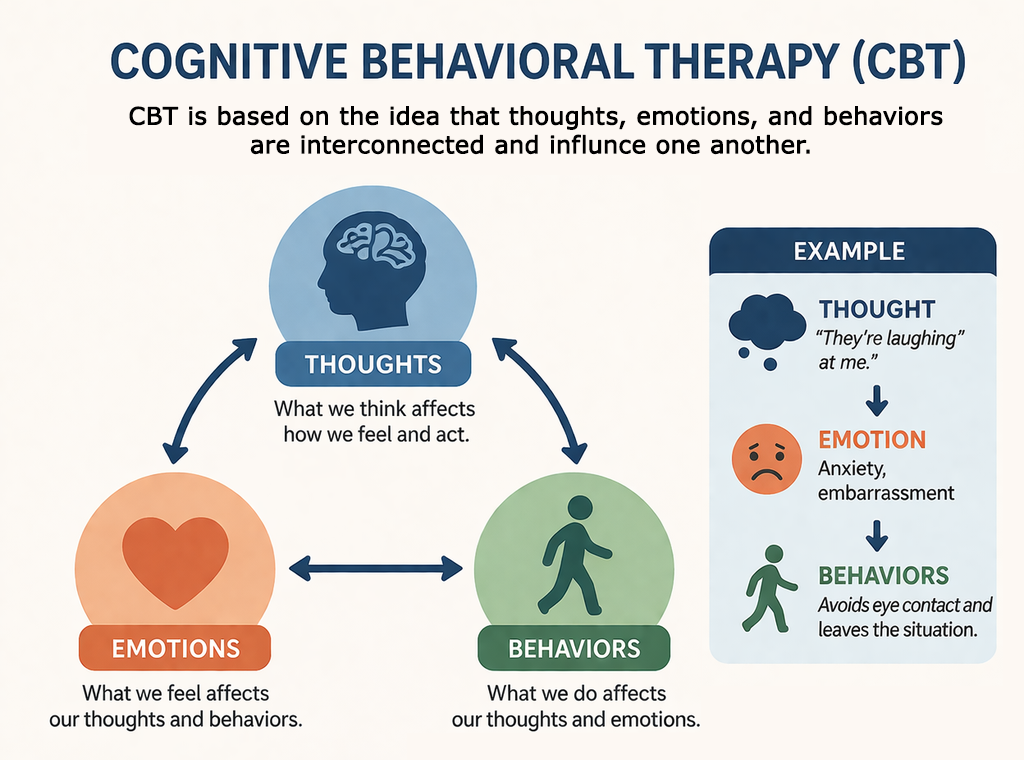
One of the most common ways Cognitive Behavioral Therapy is explained is through examples that illustrate how thoughts, emotions, and behaviors are constantly interacting with one another. According to this framework, automatic thoughts can influence emotional reactions and behavioral responses, often creating reinforcing cycles. When these automatic interpretations are negative or distorted, they can lead individuals into patterns of avoidance, anxiety, or self-destructive behaviors. CBT aims to help individuals identify these patterns and develop more adaptive ways of interpreting and responding to their experiences.
Imagine walking down a pavement and hearing a group of people laughing nearby. An automatic thought might arise that they are laughing at you. This interpretation could lead to feelings of embarrassment or anxiety, which may cause you to avoid eye contact or quickly leave the situation. CBT encourages individuals to examine these automatic thoughts and consider alternative explanations, such as the possibility that the group was laughing about something unrelated. Beck referred to these as automatic thoughts, which can occur rapidly and often go unquestioned.
Rational Emotive Behavior Therapy (REBT)
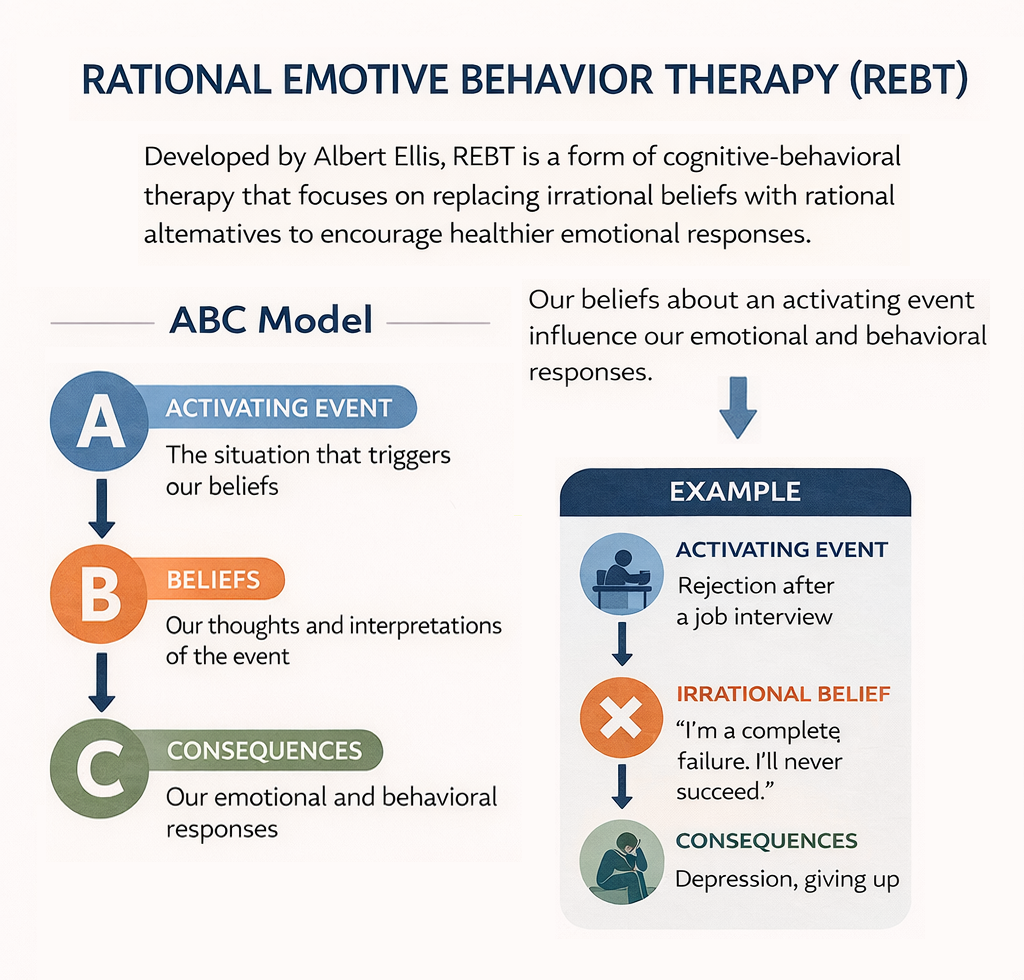
One of the earliest forms of cognitive-behavioral approaches was Rational Emotive Behavior Therapy (REBT), developed by Albert Ellis (one of the pioneers of cognitive-behavioral approaches) in the 1950s (Dryden, 2005). REBT is grounded in the idea that emotional distress is largely influenced not by events themselves, but by the beliefs individuals hold about those events: A (Activating event), B (Beliefs), and C (Consequences). According to this model, it is not the activating event that directly causes emotional consequences, but rather the beliefs about the event.
REBT places particular emphasis on identifying irrational beliefs, such as rigid demands ("I must succeed"), catastrophizing ("This is terrible and unbearable"), and low frustration tolerance, and replacing them with more flexible, rational alternatives. The goal is not simply symptom reduction, but the development of long-term emotional resilience through philosophical change.
ABC Model
The ABC model is a core framework within REBT that helps individuals understand how their interpretations of events shape their emotional and behavioral responses. Rather than viewing emotions as automatic reactions to situations, the model highlights the role of beliefs as the key mediator between events and outcomes.
A - Activating Event
This refers to the situation or trigger that initiates a response. It can be an external event (e.g., receiving criticism, failing an exam) or an internal experience (e.g., a memory or thought). Importantly, the activating event itself does not determine how a person feels.
B - Beliefs
Beliefs are the interpretations, assumptions, and evaluations we hold about the activating event. These can be rational (flexible, realistic, and helpful) or irrational (rigid, extreme, and unhelpful). It is at this stage that emotional outcomes are largely shaped. Irrational beliefs often take the form of demands, catastrophizing, or low frustration tolerance.
C - Consequences
Consequences refer to the emotional and behavioral outcomes that follow from one's beliefs. Rational beliefs tend to lead to healthier emotions (e.g., disappointment instead of despair) and adaptive behaviors, whereas irrational beliefs often result in maladaptive emotions (e.g., anxiety, shame) and unhelpful behaviors (e.g., avoidance, withdrawal).
REBT extends this model further with:
D - Disputation
This involves actively challenging irrational beliefs using logical, empirical, and pragmatic questioning. Individuals learn to question the accuracy and usefulness of their thoughts.
E - Effective New Beliefs
Through disputation, individuals develop more rational, flexible beliefs that lead to healthier emotional responses and more adaptive behaviors. By working through the ABC (and extended ABCDE) model, individuals can learn to reinterpret experiences in a way that reduces emotional distress and promotes long-term psychological resilience.
Cognitive Processing Therapy (CPT)
Cognitive Processing Therapy (CPT) was originally developed to treat individuals who had experienced sexual trauma (Resick & Schnicke, 1992), and has since demonstrated effectiveness across a range of trauma-related conditions, including work with military veterans (Chard et al., 2012).
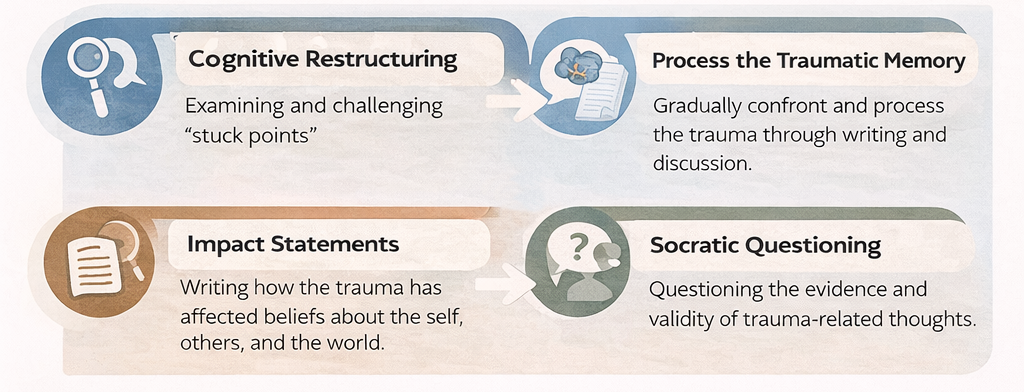
CPT is grounded in the idea that traumatic experiences can disrupt previously held beliefs, or schemas, about the self, others, and the world. Following trauma, individuals may develop maladaptive interpretations - often referred to as "stuck points" - such as beliefs related to safety, trust, control, or self-worth. These beliefs can maintain symptoms of distress by preventing the full processing of the traumatic event.
The therapy focuses on helping individuals identify and challenge these maladaptive beliefs, while gradually engaging with the traumatic memory in a structured and safe manner. Through cognitive restructuring and written or verbal processing of the event, individuals are supported in integrating the experience into their broader understanding of reality. This process allows them to recognize that the threat is no longer present, reducing the intensity of trauma-related thoughts and emotions.
| Common CBT-Based Techniques | Description |
|---|---|
| Cognitive Restructuring | Identifying and challenging distorted thoughts |
| Thought Records | Recording situations, thoughts, emotions and alternative interpretations |
| Behavioral Experiments | Testing beliefs through real-life situations |
| Exposure | Gradual confrontation of feared stimuli |
| Behavioral Activation | Increasing engagement in meaningful activities |
Disclaimer: Please note that there are a number of CBT based techniques that focus on altering our perception and understanding of everyday events, thus developing a productive mindset that focuses on progression instead of staying idle or self-catastrophizing. Almost all techniques require specialized training to apply. Most psychology-based courses will cover CBT based training.
References
- Bertolote, J. (2008). The roots of the concept of mental health. World psychiatry, 7(2), 113.
- Chard, K. M., Ricksecker, E. G., Healy, E. T., Karlin, B. E., & Resick, P. A. (2012). Dissemination and experience with cognitive processing therapy. Journal of Rehabilitation Research & Development, 49(5).
- Cook, S. C., Schwartz, A. C., & Kaslow, N. J. (2017). Evidence-based psychotherapy: Advantages and challenges. Neurotherapeutics, 14(3), 537-545.
- Dryden, W. (2005). Rational emotive behavior therapy. In Encyclopedia of cognitive behavior therapy (pp. 321-324). Boston, MA: Springer US.
- Resick, P. A., & Schnicke, M. K. (1992). Cognitive processing therapy for sexual assault victims. Journal of consulting and clinical psychology, 60(5), 748.