How sound waves form:
As we discussed in the first article in this series, perception is the accumulation of sensory input working together to create our experience of the world. While non-biological and cognitive factors certainly influence perception, we begin here by focusing on the raw data: sensory input.
In our previous chapter, we examined how different light wavelengths are perceived based on frequency, amplitude, and wavelength. Unsurprisingly, sound operates on similar principles. Let's now explore hearing—the perception of a complex arrangement of sound waves.
The Fundamentals of Sound Waves
Sine, square, triangle, and sawtooth waveforms are foundational in audio synthesis and signal processing:
Sine Wave: A smooth, continuous wave representing a pure tone with no harmonics. It is the most basic building block of sound.
Square Wave: Alternates sharply between high and low values, producing a buzzy tone with rich harmonic content. Often used in digital sound synthesis.
Triangle Wave: A pointed waveform containing only odd harmonics. Its tone is softer than a square wave but brighter than a sine wave.
Sawtooth Wave: Rises gradually then drops sharply. It contains both odd and even harmonics, creating a bright, rich sound frequently used in synthesizers.
Each waveform sounds different because of its harmonic content — the additional frequencies layered above the fundamental frequency.
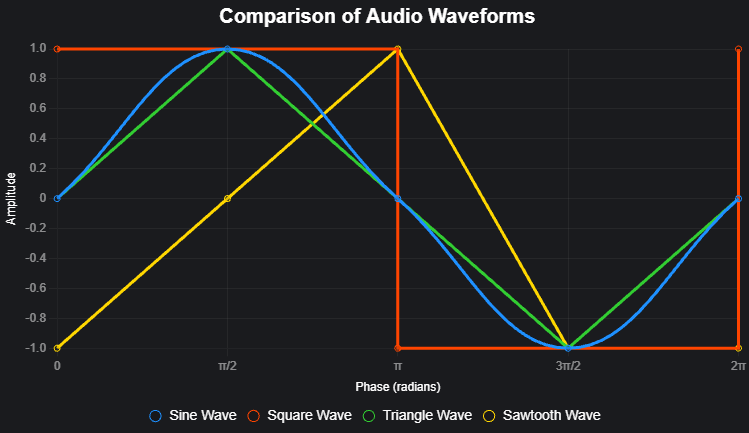
A sine wave has no harmonics — it's a pure tone.
A square wave includes only odd-numbered harmonics, giving it a buzzy sound.
A sawtooth wave includes both odd and even harmonics, resulting in a richer, brighter tone.
A triangle wave also includes only odd harmonics, but their volume drops off faster, making the sound softer.
These harmonic frequencies shape the timbre — or tone colour — of the sound, which is what allows us to tell the difference between, a violin and a flute playing the same note.
These waveforms have distinct characteristics that significantly impact the resulting sound or electrical signal. If you would like to explore around how different sound waves actually sound, feel free to explore our open-source synthesizer at https://veridiancodex.com/Synthesizer. Try creating a sine wave versus a sawtooth wave to hear the difference in timbre firsthand.
Now that we've explored the nature of sound waves, let's examine how the human ear captures and processes them
Ear Anatomy:
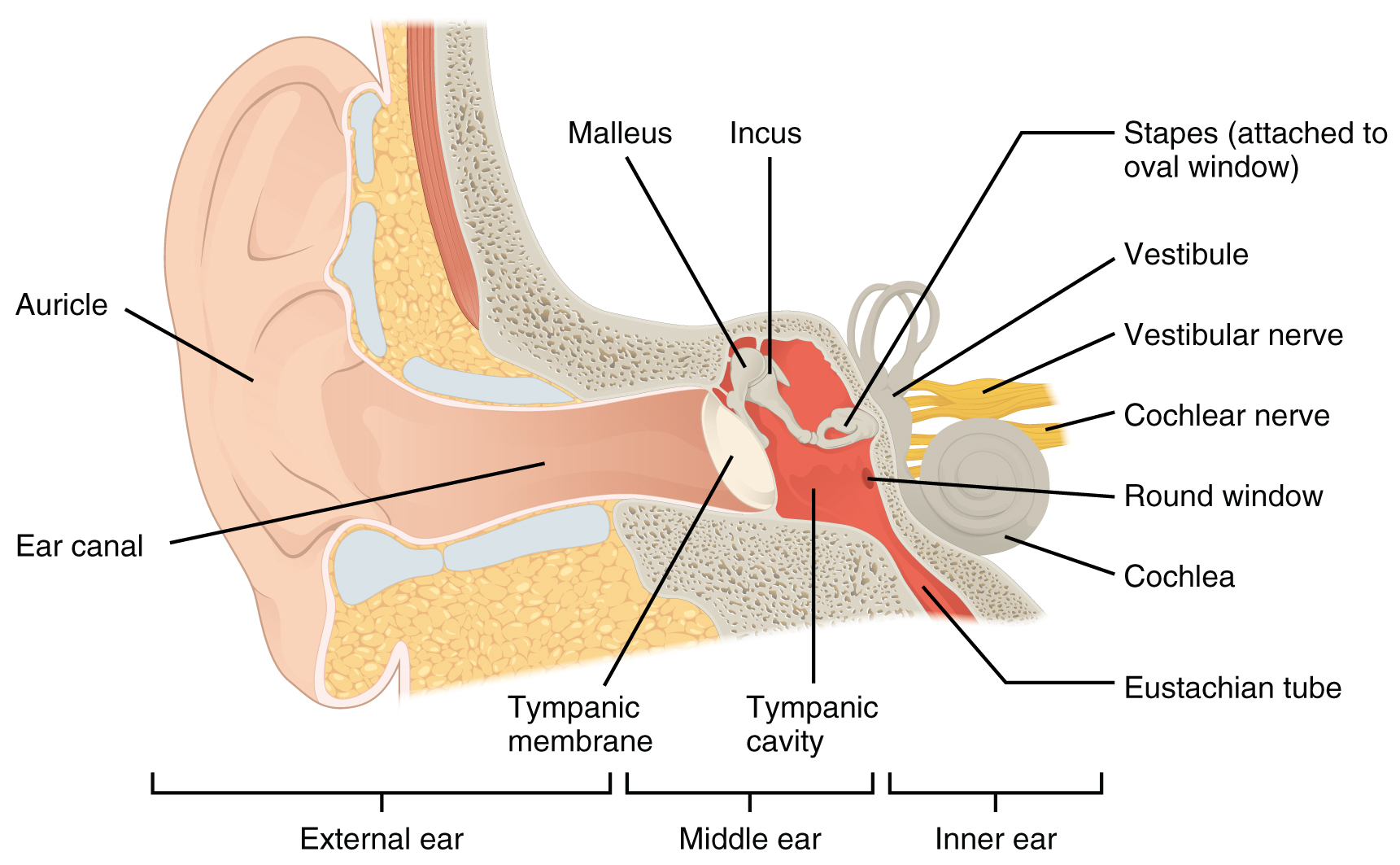
The human ear is divided into three main parts: the outer ear, the middle ear, and the inner ear. Each section plays a distinct and essential role in the process of hearing.
The Outer Ear:
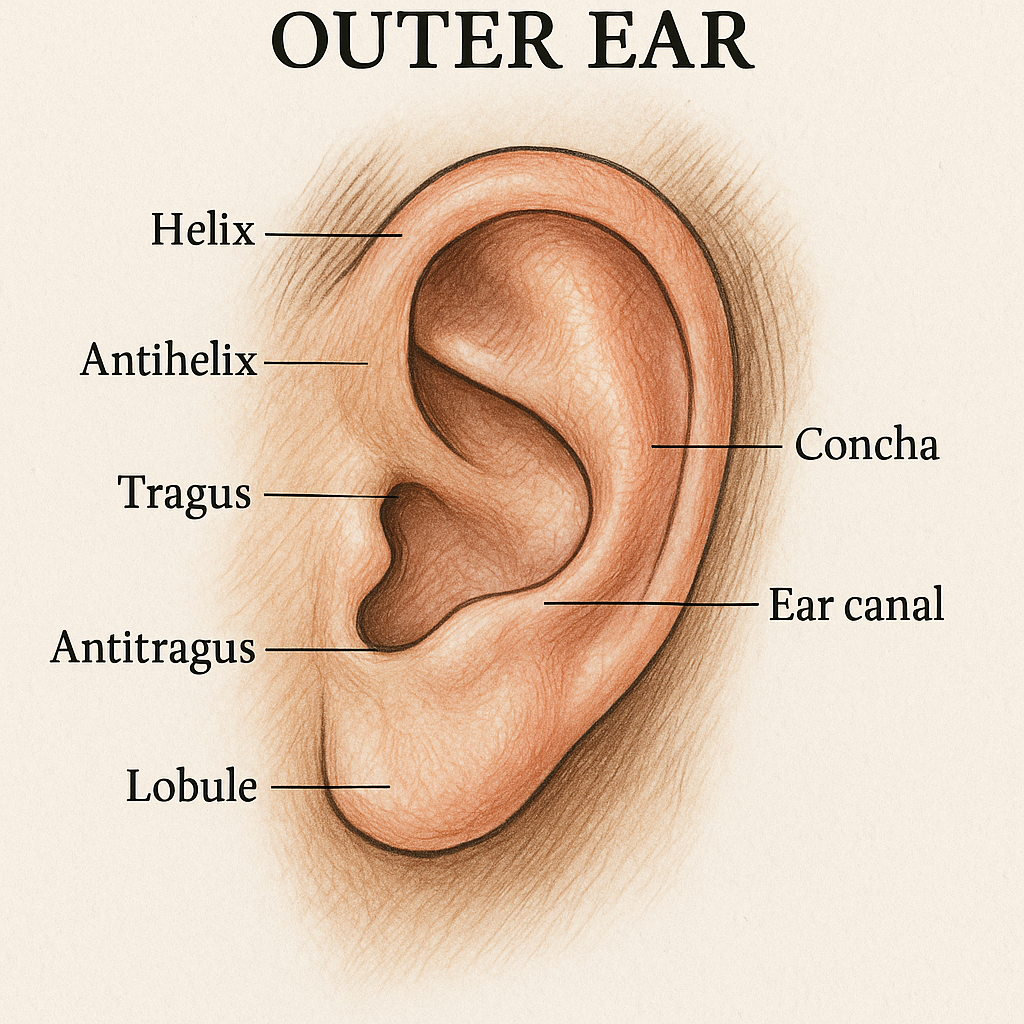
The outer ear, also called the auricle or pinna (from Latin: auricula, "little ear," and pinna, "wing"), is the visible part of the ear (Alvord & Farmer, 1997). Its primary function is to collect sound waves from the environment and funnel them into the external auditory canal (ear canal).
The shape of the outer ear helps localize sound sources by modifying incoming sound waves before they enter the ear canal. Additionally, the torso, neck, and head influence the way sound waves behave, with certain frequencies being amplified, diminished, or reflected depending on their direction and source (Mathews, 1999).
Beyond hearing, the outer ear also serves a protective function by helping to prevent the entry of dirt, debris, and insects.
Sound waves travel through the ear canal and cause the tympanic membrane (eardrum) to vibrate in response.
The Middle Ear:
The middle ear is an air-filled cavity that lies just behind the tympanic membrane. It houses three tiny bones collectively known as the ossicles: the malleus (hammer), incus (anvil), and stapes (stirrup). When the tympanic membrane vibrates in response to sound waves, these vibrations are mechanically transmitted through the ossicles. This chain of bones amplifies the vibrations and conveys them to the oval window of the inner ear.
The Inner Ear:
The inner ear can be visualized as a complex sound pressure wave receiver (Luers & Hüttenbrink, 2016). It consists primarily of the cochlea, a spiral-shaped, fluid-filled structure responsible for converting mechanical vibrations into neural signals that are interpreted by the brain as sound. Movement of the stapes at the oval window creates pressure waves in the fluid of the cochlea, which stimulate tiny hair cells inside. These hair cells translate the physical motion into electrical impulses that travel via the auditory nerve to the brain for processing. The inner ear also includes the vestibular system, which is responsible for balance and spatial orientation. Take your world for a spin.
Cymatics: Chladni Plate - Sound, Vibration and Sand
Visualization of waves
While not directly part of auditory perception, sound can also create visible patterns, as demonstrated by the fascinating field of cymatics. This visualization helps us appreciate the vibrational nature of sound waves that the ear detects and processes.
Cymatics is the study of visible sound and vibration, and one of the most iconic demonstrations of this is the Chladni plate experiment. Invented by German physicist Ernst Chladni in the 18th century, the experiment involves sprinkling sand or salt onto a flat metal plate and using a violin bow or speaker to vibrate it. As the plate resonates at specific frequencies, the sand gathers along nodal lines—areas that remain still—forming intricate geometric patterns. These visual representations reveal how sound waves and vibrations organize matter, offering a stunning glimpse into the physical behaviour of sound.
Auditory Illusions and Phenomena
1. McGurk Effect (audio + visual)
• What it is: When a spoken syllable (like "ba") is dubbed over video of someone saying "ga", the brain hears "da"—a fusion of sight and sound.
• Relevance: Shows how hearing is not just about the ear but also about sensory integration in the brain.
• Ear anatomy tie-in: Great for showing that the ear sends raw data, but the brain constructs perception.
2. Phantom Words Illusion
• What it is: Repeated indistinct speech sounds eventually form recognizable words in the listener's mind.
• Relevance: Demonstrates auditory pattern recognition.
• Ear anatomy tie-in: Links to how the auditory nerve and cortex shape perception.
Plenty of these examples can be found online. Explore the limits of your own perception.
Waveform Comparison Table
| Waveform | Harmonics | Sound Characteristics | Example Use |
|---|---|---|---|
| Sine | None | Pure, smooth tone | Basic tones in synthesis |
| Square | Odd only | Buzzy, hollow | Digital synths, alarms |
| Triangle | Odd only (fading volume) | Soft, bright | Flute-like sounds |
| Sawtooth | Odd and even | Rich, bright | String instruments in synths |
References
- Alvord, L. S., & Farmer, B. L. (1997). Anatomy and orientation of the human external ear. Journal of the American Academy of Audiology, 8(6).
- Luers, J. C., & Hüttenbrink, K. B. (2016). Surgical anatomy and pathology of the middle ear. Journal of anatomy, 228(2), 338-353.
- Marchioni, D., Molteni, G., & Presutti, L. (2011). Endoscopic anatomy of the middle ear. Indian Journal of Otolaryngology and Head & Neck Surgery, 63(2), 101-113.
- Mathews, M. (1999). 1 The Ear and How It Works.
Image for this article was collected from Wikimedia Commons.