Proprioception
Proprioception, often overlooked, is the body's remarkable ability to sense its own position, movement, and orientation in space. Unlike the traditional five senses, it operates beneath conscious awareness, relies on internal stimuli, depending on on specialized receptors in muscles, tendons, and joints to relay information to the brain (Tuthill & Azim, 2018). This "sixth sense" enables fluid coordination, balance, and spatial awareness—think of walking without looking at your feet or typing without staring at your hands.
Kinaesthesia as the sense of movement, equilibrioception as the sense of balance and spatial orientations.
The Somatosensory system of the body receives information from mechanoreceptors found in the muscles, joints and skin. Mechanoreceptors allow for the body to contribute to the sense of posture (Macefield, 2021), provide crucial feedback for actions like how much strength we apply during an action (i.e. grabbing), tactile sensations and muscle/skin stretch and tension (Johnson, 2001).
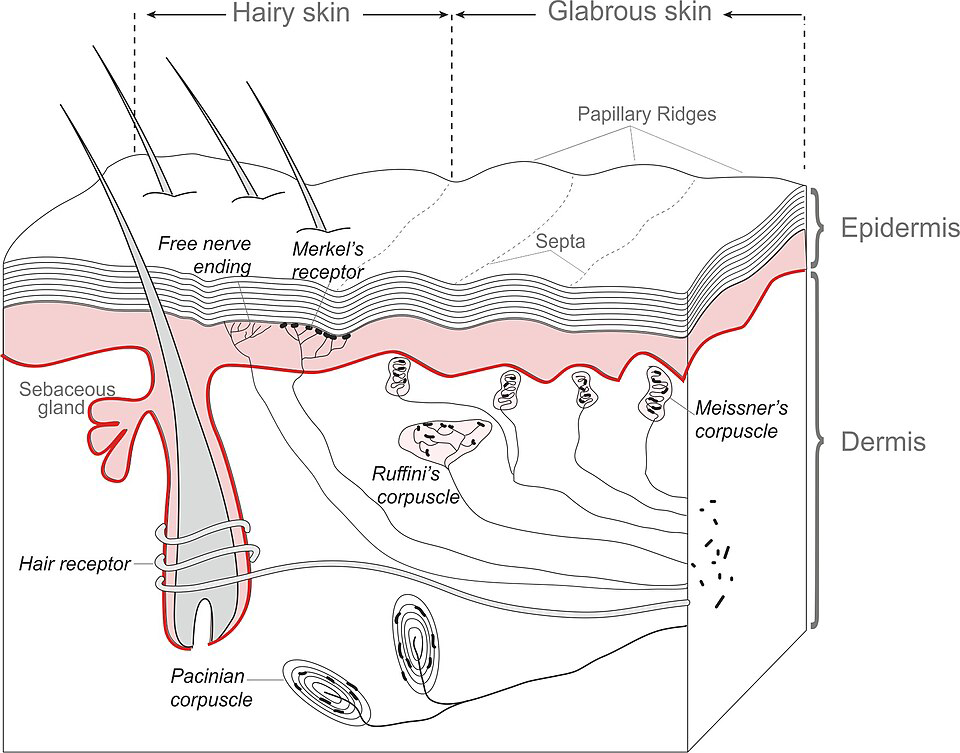
When it comes to balance, muscular strength and joint stability is crucial (Han et al., 2015) but also other organs come into play like the ears through the peripheral vestibular system and of course vision. The peripheral vestibular system provides crucial information about head movements and spatial orientations (Kanegaonkar et al., 2012). Proprioception is a field of study of much interest especially in various sports.
Illusions reveal our body's vulnerabilities and limits
On the contrary though, "illusions" can provide beneficial outcomes such as social and romantic possibilities.
1. The social softness illusion
The tendency to perceive other's skin as softer than ours. Promotes sociability through the rewarding nature of a social or romantic touch.
2. Charpentier Illusion
When size interrupts the sense of weight. Charpentier Illusions occur when two masses of equal weight are perceived differently due to different sizes.
This is the last mini chapter regarding the main senses. I hope you enjoyed it and learned something new. The final chapter will introduce other senses and how they work together to create our perception of the world. If you have any questions or feedback, please feel free to reach out.
Thank you for reading!
References
- Han, J., Anson, J., Waddington, G., Adams, R., & Liu, Y. (2015). The role of ankle proprioception for balance control in relation to sports performance and injury. BioMed research international, 2015(1), 842804.
- Johnson, K. O. (2001). The roles and functions of cutaneous mechanoreceptors. Current opinion in neurobiology, 11(4), 455-461.
- Kanegaonkar, R. G., Amin, K., & Clarke, M. (2012). The contribution of hearing to normal balance. The Journal of Laryngology & Otology, 126(10), 984-988.
- Macefield, V. G. (2021). The roles of mechanoreceptors in muscle and skin in human proprioception. Current opinion in physiology, 21, 48-56.
- Tuthill, J. C., & Azim, E. (2018). Proprioception. Current Biology, 28(5), R194-R203.
Image for this article was collected from Wikimedia Commons.